From Discovery to Disease:
The Right Tool for Every Patient
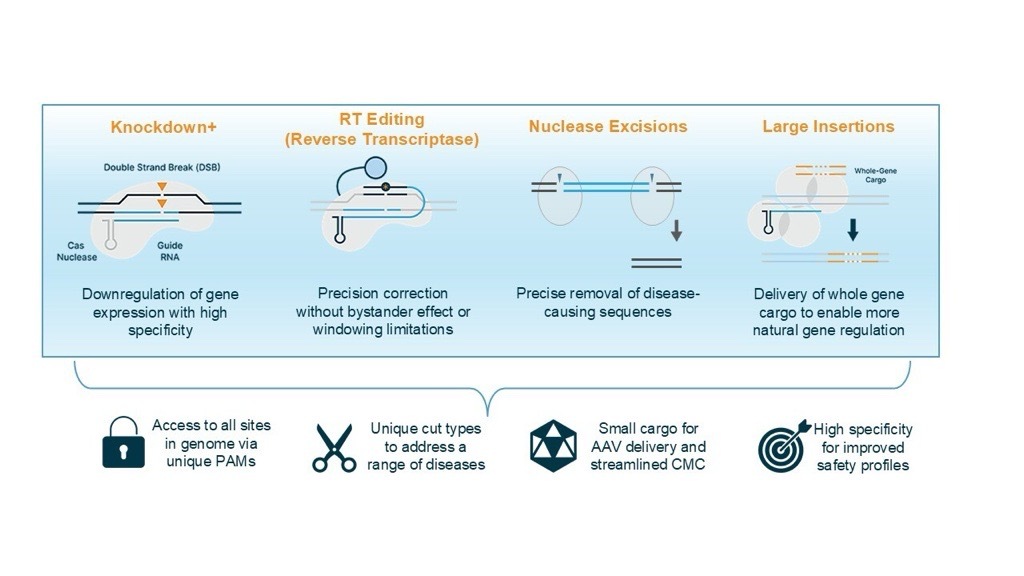
We are built differently. We have developed four distinct editing modalities, each designed to match the specific demands of a disease, not the other way around. This gives our scientists the flexibility to ask: what does this disease require and then find the right answer.
Knockdown+ — For diseases driven by toxic protein overproduction
Some diseases are caused by a gene producing too much of the wrong protein. Knockdown+ uses compact nucleases with precise large-deletion patterns to silence the target gene durably and effectively. Small enough to fit within a single AAV capsid, these editors are purpose-built for systemic delivery — including to the CNS.
Precision (RT) Editing — For diseases requiring exact genetic correction
Some diseases turn on a single wrong letter in the genome. Precision RT editing corrects the sequence at that exact location — without disturbing surrounding DNA. With broad PAM compatibility and no windowing limitations, this modality opens targets that other approaches cannot reach with the same fidelity.
Nuclease Excision — For diseases driven by a genetic sequence that shouldn’t be there
When the disease driver is a sequence that needs to be removed entirely, Nuclease Excision delivers. Our compact effectors fit within AAV alongside multiple guide RNAs — enabling precise, multiplexed excision of disease-causing elements with a single therapeutic.
Large Insertions — For diseases requiring restoration of a missing or non-functional gene
Some diseases can only be addressed by putting something back. Our transposon-based large insertion approach enables integration of functional gene sequences into endogenous loci — allowing more natural gene regulation and durable therapeutic effect. A single product can address patients with different underlying mutations.
We don’t start with our tools. We start with the patient and select the approach their disease demands.